
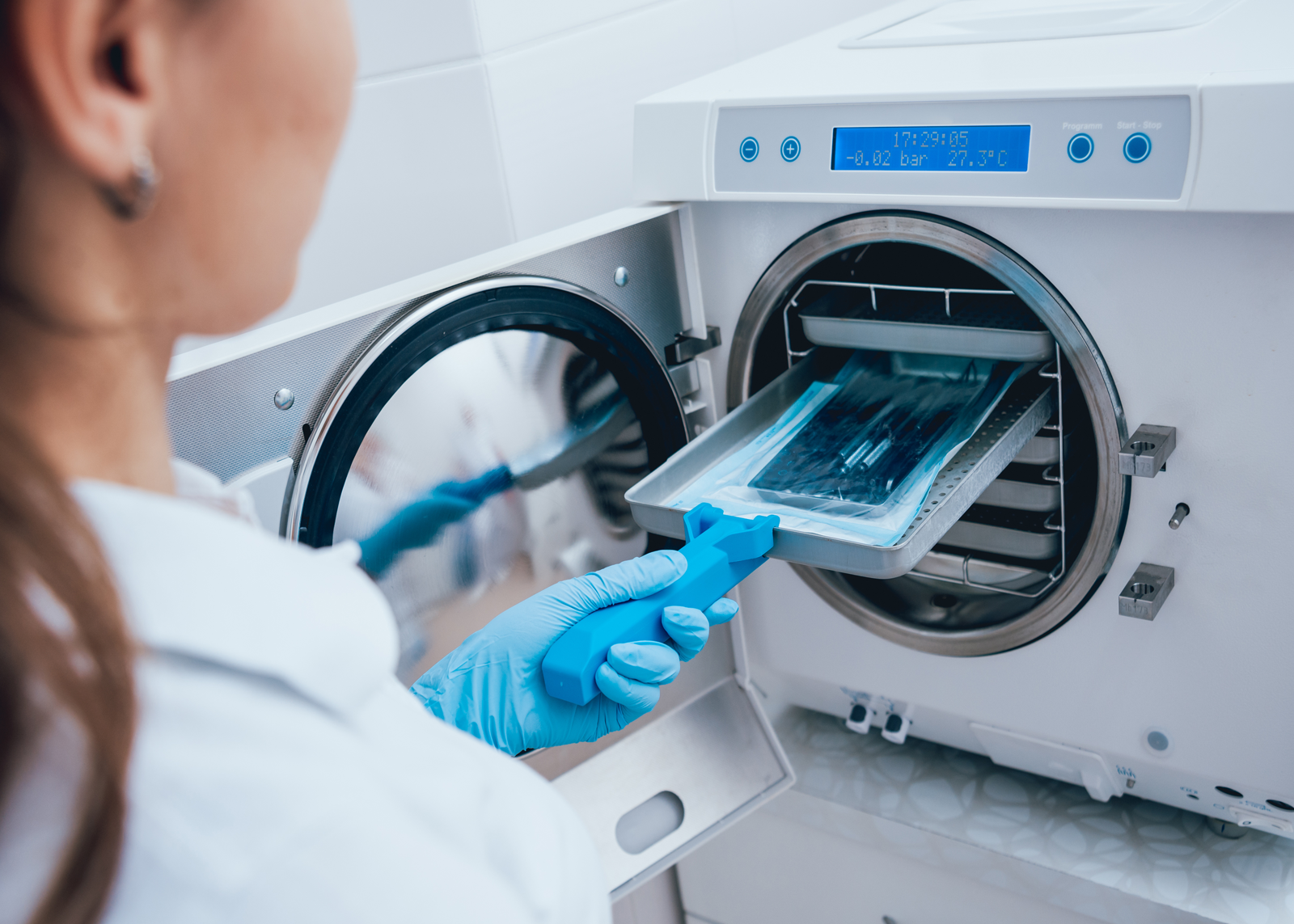
What Is an Autoclave, and What Are the Most Common Repairs?
Walk into almost any dental office, veterinary clinic, surgery center, or community health center, and somewhere out of sight there’s a machine quietly doing one of the most important jobs in the building — sterilizing the instruments that touch the next patient. It runs a load, cools down, gets emptied, and does it again dozens of times a day. That machine is the autoclave, and when it stops working properly, the whole practice feels it.
Describing what an autoclave does is easy. Keeping one running reliably — cycle after cycle, year after year — is the part that takes real expertise. Here’s what an autoclave actually does, why these machines fail, and which sterilizer repairs our technicians see most often.
How an Autoclave Actually Works
An autoclave sterilizes instruments using pressurized steam — that’s the whole principle in one sentence, but the details are what make it work.
Water boiled in an open pot tops out at 212°F (100°C), and that simply isn’t hot enough to reliably kill the toughest bacterial spores. An autoclave gets around this by sealing the chamber and building pressure, which raises the boiling point and lets steam climb well past 212°F. A typical cycle holds instruments at roughly 250°F (121°C) or 270°F (132°C), under about 15–30 psi of pressure, for a set number of minutes. Heat, pressure, and time together — that combination is what destroys bacteria, viruses, fungi, and the heat-resistant spores ordinary disinfecting leaves behind.
Most clinics run a tabletop steam sterilizer rather than a large floor unit. The Midmark and Ritter M-series are everywhere in dental and medical practices, and Tuttnauer, Sci-Can Statim, and Pelton & Crane units are common too. They differ in how they remove air from the chamber and how quickly they cycle — but they all depend on the same three things: clean steam, accurate temperature, and held pressure. When any one of those slips out of range, the load doesn’t get sterilized, even if the cycle appears to finish normally.
That last point is why autoclave problems are taken so seriously. A sterilizer that looks and sounds fine can still be failing silently — which is exactly why spore testing and regular maintenance matter as much as they do.
Why Autoclaves Break Down
Autoclaves live a hard life. They heat up and cool down many times a day, sit under pressure, and run hot, mineral-laden water through seals and valves that were never going to last forever. Three things drive most of the failures we see:
- Simple wear. Gaskets, valves, and heating elements are consumable parts with a finite service life — and high-volume practices reach the end of it faster.
- Water quality. This one is badly underrated. Tap water carries dissolved minerals that bake into scale on heating elements, inside chambers, and across valve seats every time the unit cycles. Over months, that scale clogs lines, jams valves, and insulates elements so they overheat and burn out early. Using distilled or properly treated water is the single biggest thing a practice can do to protect its sterilizer.
- Missed maintenance. A gasket that gets wiped down and a chamber that gets cleaned on schedule will outlast one that’s ignored until it leaks. Small problems caught early are cheap — the same problems caught after a failed load are not.
The Most Common Autoclave Repairs
When a clinic calls us about a sterilizer, the problem usually traces back to one of a handful of culprits.
- Door gaskets and seals. This is the repair we see more than any other. The gasket ringing the door is rubber, and rubber hardens, cracks, and flattens with heat and age. A worn gasket lets steam escape — so the chamber can’t build or hold pressure, cycles run long or abort, and you’ll often spot steam hissing from the door or moisture pooling underneath. Replacement is routine, but a leaking seal left alone throws off every cycle in the meantime.
- Heating elements and slow heat-up. If the unit takes far too long to reach temperature, never quite gets there, or errors out partway through, the heating element is a prime suspect. Elements degrade naturally, and scale buildup speeds the process by forcing them to overheat. A failing element usually shows up first as longer cycle times before it dies completely.
- Water and fill problems. A sterilizer needs the right amount of clean water entering the chamber at the right moment. Clogged fill lines, a faulty fill or water solenoid valve, a sticking float, or a fouled reservoir can all interrupt that — producing low-water errors, cycles that won’t start, or chambers that never reach pressure. Mineral scale is behind a large share of these calls.
- Pressure that won’t build or hold. When the chamber can’t reach target pressure — or reaches it and bleeds off — the load isn’t being sterilized, even if the timer runs out. The cause might be a leaking gasket, a failing valve, a clogged line, or a pressure relief valve venting when it shouldn’t. Because pressure and temperature are linked, a pressure fault almost always means a temperature fault too.
- Temperature sensor and control faults. Every sterilizer relies on sensors to know it’s hit the right temperature. When a thermostat, thermocouple, or probe drifts or fails, the unit may cut cycles short, run too hot, or report readings that no longer match reality. These calls often need recalibration, not just a part swap.
- Valves and solenoids. The small valves that admit water, release steam, and drain the chamber take a beating and fail often. Scale and debris make them stick or leak, which shows up as pressure problems, water in the wrong place, or cycles that stall.
- Drain and exhaust clogs. A chamber that won’t drain or vent properly leaves instruments wet at cycle’s end, throws off pressure, or backs up entirely. Scale, debris, and biofilm in the drain path are the usual suspects, and clearing them is normal service work.
- Control boards and electronic faults. Newer digital units add another failure category — cryptic error codes, frozen displays, dead buttons, and cycles that interrupt for no obvious mechanical reason. These need a technician who knows the specific platform, not a parts swap based on guesswork.
- Door latch and safety interlocks. The mechanism that keeps the door sealed under pressure is also a safety system. When the latch wears or the interlock sensor fails, the unit may refuse to start — or behave unpredictably. This is not a repair to put off.
- Failed spore tests. A failed biological indicator is a symptom rather than a single broken part, but it’s one of the most important reasons a sterilizer gets serviced. It means the autoclave isn’t achieving true sterilization, and the cause is usually one of the faults above. It needs to be diagnosed and corrected before the unit goes back into clinical use.
Repair or Replace?
A surprising number of sterilizers get written off too early. A tabletop autoclave that’s ten or fifteen years old can often run for many more years on routine parts and proper care — and replacing a perfectly serviceable unit is an expensive way to fix a problem a gasket and a descaling would have solved. Replacement genuinely makes sense in some cases, usually when parts are no longer available or repeated major failures stack up. But that’s a call worth making with a technician who’ll tell you honestly which way the math points.
Keeping Your Autoclave Out of the Repair Shop
Most autoclave repairs are preventable — or at least delayable — with a few habits:
- Use distilled or treated water, every time. This single change prevents the scale behind a huge share of repairs.
- Inspect and wipe down the door gasket regularly. Catch hardening and cracks before they turn into steam leaks.
- Clean the chamber and trays. Keep debris from migrating into valves and drains.
- Stay on a preventive medical equipment maintenance schedule. Don’t wait for something to break.
- Run your spore tests on schedule. If the unit ever starts to fail, you want to catch it on a test strip — not after a day of patients.
A sterilizer that’s cleaned, watered correctly, and serviced on a regular cadence simply doesn’t break down the way a neglected one does.
When You Need a Sterilizer Back in Service
When an autoclave goes down, a practice can’t just wait it out. CalMed Inc. has been servicing sterilizers for healthcare facilities across Connecticut, Massachusetts, Rhode Island, and New York for four decades. Our technicians are authorized Midmark and Ritter repair specialists — and fully qualified on Tuttnauer, Sci-Can, and Pelton & Crane units as well. We handle emergency medical equipment repairs, preventive maintenance, inspection, cleaning, testing, and calibration; we perform the majority of repairs on-site; and we provide a free loaner when a unit has to come back to our facility. Every repair is backed by our 90-day warranty.
If your autoclave is leaking, throwing errors, failing spore tests, or simply not cycling the way it used to, contact the CalMed team or call (203) 315-8121. We service healthcare facilities across CT, MA, RI, and NY, 7 days a week.